Whitney Biennial videos


This year the Whitney has produced videos featuring many of the artists included in the Biennial which is currently on view. The videos are well produced, unlike 90% of the video you will find on the arts. No shaky-cam here and the subjects are actually lit pretty well. The audio is good too, the biggest short fall in most amateur video.

The exhibition itself is less noisy than I expected. It appears to me like the artists were used as pieces of furniture to arrange and to make a nice room display by the curators and exhibition designers. Maybe this is why most of the works don't have much impact, that might disrupt or compete with the rest of the room display. Then there is the fact that there is so much derivative work by these mostly young artists that it makes you wonder if they don't know that they are copying or they think that being original isn't important at all. Jerry Saltz has a very good piece on artnet on this topic called Wasted Youth.

When Cool Turns Cold, Jerry Saltz on the Whitney Biennial 2008.

Above, a still from the video on sculptor Jedediah Caesar from the Whitney's Focus series.

Greatest Artworks in the Universe! By David Foss


Last year I was reading the fascinating book by author Graham Hancock titled Supernatural on his theories of how prehistoric cave art was created by shamans under the influence of hallucinogenic substances. Mid-way through the far ranging book, Hancock brought up the topic of crop circles, which shook my memories back to the early 70's when I first heard about such unusual phenomenon. I remember hearing about crop circles being found in British farmlands back then, but did not give it much notice when news broadcasts reported that the mysterious circles were man-made hoaxes, not created by some aliens.

My interest piqued again, when the topic of crop circles was brought up by best-selling author Daniel Pinchbeck in his recent book 2012: The Return of Quetzalcoatl. So I did some research on the topic through a search of Google and found some fascinating websites on the phenomenon. Check out links below for some great visuals and essays. Now you, can do your own research and make up your own mind as to the origins of the crop circles made by the so called Circle Makers. But what shocked me as I started to look at more of the aerial photographs of these crop circles was, just how wonderful they are as artworks. I had no idea just how large and how geometrically complex these works are and how the phenomenon has continued since the 70's right up to the present day. Actually, the crop circle, devil's or fairies' circle phenomenon is very old in the historical record dating back hundreds of years.

Serious scientific research is being conducted on this unusual phenomenon that now spans the globe. Certainly some of the circles are man-made hoaxes, experts in the field can easily tell them apart from the circles that are just too complex and quickly formed to be made by humans. But whoever or whatever is making these things, the reader can make up their own mind. I just want to say, these crop circles are Great Art and perhaps the Greatest Artwork being made in the entire universe. Or at least in these four-dimensions.

The circles are wonderfully beautiful in their geometric designs, laid out in grain fields in swirling patterns. The connections to fractal mathematics, esoteric mystical traditions, or sacred geometry makes the crop circle phenomenon into a fascinating depiction of meaningful codes. What the coded messages are saying, if anything, is anyone's guess, but I think at the next Whitney Biennial, the curators should consider these popular art icons as seriously as they do Smithson's "Spiral Jetty," Andy Goldsworthy, Richard Long, or other modernist earthworks.

– David Foss, artist and Director of DaVinci Art Alliance

Sources
X-Cosmos
Lucy Pringle
Crop Circles Secrets
Crop Circle Research

Graduate Shows


There are many, many graduate exhibitions, too many to mention here. But you can get information for Penn shows here and for Tyler here. Artblog does a good job of covering young artists in Philadelphia including the graduate shows.

Above image from PAFA The Pennsylvania Academy of Fine Arts, MFA graduate Karen Baumeister. Detail of her painting "Green, It's Good for You." Acrylic on canvas 68 x 64 inches, 2007. Her work can be seen at the Second Floor Tuttleman Sculpture Gallery. Preview party info. Free public reception info.

Weighing In on Size, by Jon Manteau


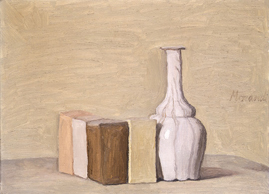
Still Life, 12 x 16 inches, oil on canvas 1955, by Giorgio Morandi. National Gallery of Art, Washington DC

When I saw an article on small painting vs. large painting, I thought immediately of Jon Manteau. I remembered a conversation we had about it when I taped him in his studio, here and here. In the following piece he gives us his unique view on this subject from the perspective of someone who creates paintings as large as 8 x 12 feet. Scroll down for links to other articles and opinions on this topic. Vincent Romaniello

There seems to be a lot of discussion these days about the merits of small-scale art verses large scale works. I find the subject to be annoying and ultimately a waste of time. For me, this dialog is akin to politico's using race as a divisive issue. It's tired!!! This is not to say that race, racial equality or racism are dead issues, on the contrary, humanity’s capacity for hate and genocide will in all likelihood never entirely disappear. Our history is rife with it! The analogy that I'm attempting to make is, large-small, black-white, hetero-homo, blue states-red states, you-me, us-them, apples-oranges, etc, etc. On many levels, this dialog is counter-productive and when used to divide or to polarize it can become a slippery slope. Enough with the soapbox preaching for now, it's Election Day, so back off.

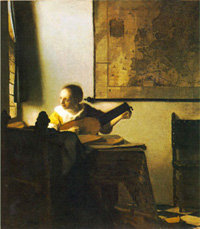
Small verses large, does it really matter, as long as the work gets the idea or message across to the audience in the most effective possible way? Smaller works have traditionally functioned as studies, sketches, vignettes or windows. Like looking through a viewfinder or peephole. When I think about the effectiveness of smaller works and their ability to draw one in, Johannes Vermeer immediately comes to mind. I think that when one views a Vermeer painting, we are observers, voyeurs. We are allowed to view what he has chosen for us to see but we are definitely not participants in his landscape. We are just onlookers.


Johannes Vermeer, Woman Playing a Lute near a Window, after 1664, oil on panel, 20.25 x 18 inches, Metropolitan Museum of Art.

I find that something very different occurs when the scale of a painting increases. It’s the “macro” (large, inclusive), as opposed to the “micro” (very small). The viewer becomes part of the landscape. Color and iconography surround, envelope or wrap around the viewer. I'm not attempting to diminish the importance of either small or large. They just function in different ways. Would Picasso’s “Guernica” be as powerful if it were 12 x 27 inches as opposed to its monumental size of 12 x 27 feet? Would Michelangelo's Sistine Chapel ceiling make the same statement if it were the size of a postage stamp? By the same token, would a Giorgio Morandi still life make any sense at all if it were 8 x12 feet?


Guernica, by Pablo Picasso, 12 x 27 feet,
oil on canvas, 1939, Museo Reina Sofia, Madrid.

Back to the future, does a Julie Mehretu large scale piece have the same intent as does one of her smaller works? The point is this, it's all about intent. It shouldn't matter whether a work is large or small as long as it serves the artist's cause. We can debate the merits of "large just for large" in a sensationalist, market driven, environment just as we can debate "small for small" because everyone can own one. Art as spectacle is very different than art with serious gravitas. Bigger isn't better, if it ain't better. Small isn't better, if it's mediocre or lacks ambition. Sometimes less is more, but sometimes less is just less.

– artist, educator, Jon Manteau


Empirical Construction, 2003, acrylic and ink on canvas, 9'8" x 14'7", by Julie Mehretu.

Is Painting Small the Next Big Thing? Roberta Smith, NY Times.

Response Blue Vertical Studio

Small talk with Roberta Smith Two Coats of Paint

Post Primary Levity

People who know me well know that I don't like humor, only kidding. I never send silly videos to my friends and because this humorous piece is so scary, I don't think I have broken that rule yet.


Diebold Accidentally Leaks Results Of 2008 Election Early

New Home, Clean Slate


Above, Untitled. 2008, acrylic, Venetian plaster, cement and gold leaf on canvas, 12x24 inches, by Long Island artist Lynn Dunham.

I decided to launch Romanblog II as a kind of sequel to the original Romanblog. I did this because my motivation has changed as did the world of blogging and vlogging. When new low cost technology made it possible to make video documentaries five years ago I thought it was the perfect opportunity to bring attention to artists who were under recognized. Since then many things have changed including a new YouTube culture. And my mission has been changed and formed by those who write me and by the needs of the art community that should be obvious to all.


Above, Anne, 2004, acrylic, embroidery and gel medium on canvas, 66x79 inches, by Egyptian artist Ghada Amer.

One thing that hasn't changed is that the same individuals and groups get all of the media attention. Why bother writing 4 pieces on one blog about Frida when every single newspaper and blogger already has written their 4 pieces on the show? When this happens we lose countless opportunities to hear about other deserving institutions, galleries and individual artists.

My mission now is to continue to feature artists that readers might not be aware of for a variety of reasons. This could be because these artists have been left out of the conversation by critics and the mass media. That they are from other parts of the world. That they do work that is not considered "new" or whatever it is that the experts deem worthy. Maybe they don't belong to the right "group" and hence don't have a support system to be advocates for them. I could go on but instead maybe you would like to add your comments below.

I will also continue to document artists and organizations on video and will present them here. Currently I am working on a large project involving a partnership of two local art groups that will include approximately six artists and a curator. This summer I will be documenting the "International Turning Exchange 2008" as a resident fellow and will share some clips with you here.

For Romanblog II I will be asking other artists, writers and art lovers to write posts. So send me your ideas at vincent at vincentromaniello dot com.